The West University Median Is a Blend, Not a Benchmark

Open three different real estate sites and search West University Place on the same afternoon, and you will get three different stories about where prices stand. One shows a median sale price of $1,640,000 over a recent 30-day window, down 23.1 percent from a year earlier. Another puts the median at $1,933,948 as of June 2026, up 4.5 percent year over year. A third, published this September by Hoodline, ties the neighborhood's median to $2.17 million. None of these sources is wrong. They are measuring a market that behaves less like a single neighborhood and more like two separate product categories that happen to share a zip code.
That zip code, 77005, is not incidental. West University Place is a fully independent, home-rule city of roughly two square miles, incorporated in 1924, completely enclosed by Houston, with its own mayor, council, police department, fire department and public works. It opted out of consolidating with Houston back in 1939 and never looked back. That independence matters for reasons beyond civic trivia. It shapes the economics of every lot inside its borders, and it explains why the median price swings the way it does.
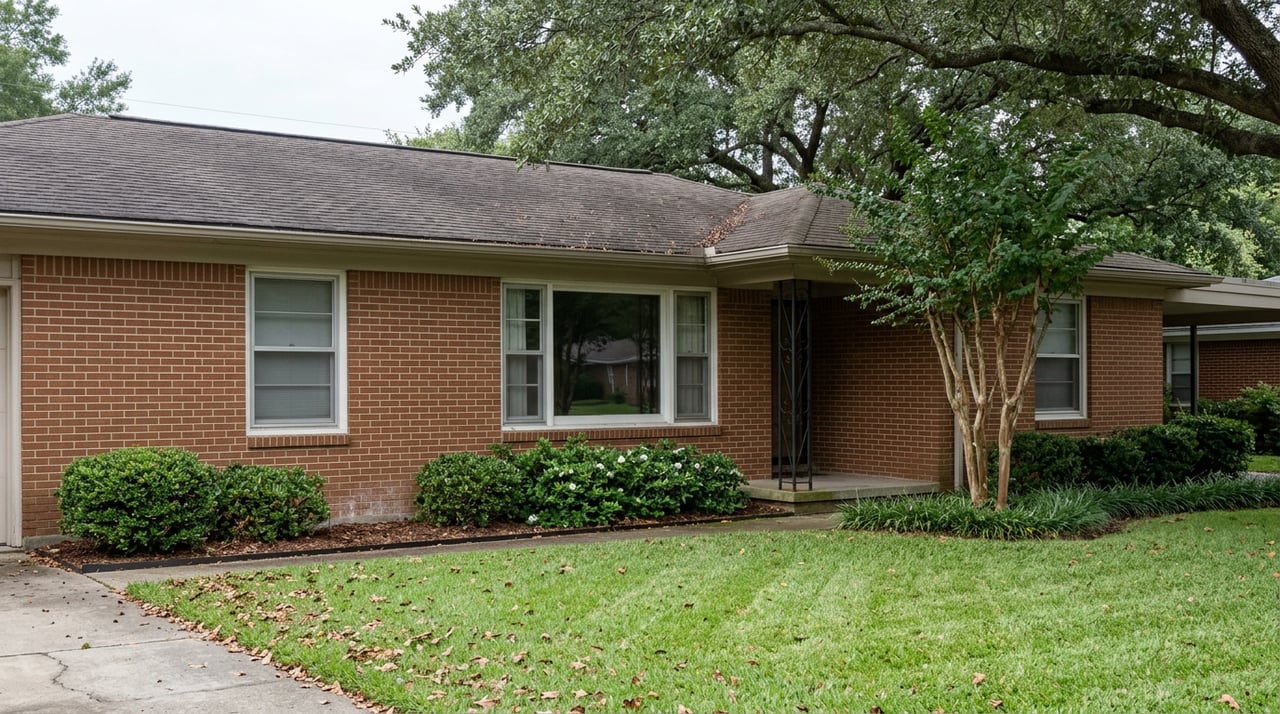
Here is the mechanism. In West University, a 1940s-era cottage on an unimproved lot sells for around $1.4 million based on land value alone. A new custom build on that same size lot lists for close to $3.8 million once construction is finished, according to a June 2026 report cited by Hoodline. Those are not two prices for the same house at different points in its life. They are two distinct products, an unimproved lot and a finished spec home, that both get counted under the single heading "West University Place median sale price" depending on what happened to close that particular month.
When more original bungalows and teardown candidates change hands in a given window, the median drops, because those transactions are priced closer to raw land value. When more finished new construction closes, the median jumps, because those transactions carry the cost of the house on top of the lot. Neither swing reflects the neighborhood getting cheaper or more expensive on a like-for-like basis. It reflects which product mix happened to trade.
This is not a new phenomenon dressed up as one. Houston builder Dan Parker described the same dynamic in West University Place decades ago, telling Texas Monthly that buying into the neighborhood at the time felt like "buying the potato and getting the steak for free," meaning the lot itself had become worth more than the house sitting on it. The mania Parker was describing has never really stopped. It has simply compounded, block by block, until land value now dwarfs almost everything built on top of it.
Here is a snapshot of what different sources reported for West University Place over roughly the same stretch of 2026. The spread is the point.
| Source | Window | Figure | Change reported |
|---|---|---|---|
| Redfin | October 2025 (monthly) | $2.0 million median | up 31.4% year over year |
| Redfin | trailing period through June 2026 | $1,933,948 median | up 4.5% year over year |
| HAR.com | July 2026 | $2,152,300 average, $571 per square foot | |
| HAR.com | August 2026 | $2,479,460 average, $615 per square foot | |
| Orchard | trailing 30 days | $1,640,000 median | down 23.1% year over year |
A buyer scanning that table might conclude West University Place is either cooling sharply or accelerating, depending on which row lands in front of them first. The more useful read is that the neighborhood traded a different mix of product in each of those windows. A month heavy on teardown-candidate closings pulls the median down. A month heavy on finished new construction pulls it back up. Both are true statements about the same 30 to 60 transactions a year the neighborhood typically produces, which is a small enough sample that a handful of high-end spec closings can move the average by hundreds of thousands of dollars.
West University's building code requires that 40 percent of every lot remain open space, and most lots run around 5,000 square feet. That ceiling on footprint means the only real way to add significant living space is to build up and finish out, not to acquire more land, because there is essentially none left to acquire inside a two-square-mile city that has been fully platted for a century. Scarcity of buildable dirt, combined with a buyer pool willing to pay for both the address and the schools, is what keeps land value climbing even when the finished-home median dips for a quarter.
The city's own fiscal posture reinforces the pattern. West University Place approved a fiscal year 2026 budget that included $46.5 million in capital infrastructure improvements while holding its municipal property tax rate at $0.229 per $100 of valuation, a rate that stays below Houston's own. Independent police patrols correspond with crime rates reported roughly 50 percent below the greater Houston metro average. None of that shows up in a median sale price, but all of it supports the willingness of buyers to pay a premium for dirt inside these particular borders rather than dirt two miles away.
That premium recently earned West University Place a place in a national ranking most residents will not have seen coming. A GoBankingRates study pairing Census American Community Survey income data with Zillow Home Value Index figures through January 2026 placed the city at No. 2 among America's wealthiest suburbs, trailing only Scarsdale, New York. Average household income in West University climbed from $294,723 a decade earlier to $439,594 in 2024. Scarsdale's average household income sits at $612,591 with an average home price near $1.46 million as of January 2026, a reminder that West University's land-value math runs even hotter than the town that still beats it on income.
Bellaire, another independent city fully surrounded by Houston, climbed the same ranking from 23rd to 18th place, with average household income rising from $226,295 in 2014 to $335,492 in 2024. The pattern of small, self-governing, land-constrained cities inside a larger metro commanding outsized price growth is not unique to West University. It is a structural feature of how these particular enclaves are built, literally and legally.
If the monthly median is telling you which product traded rather than what the neighborhood is worth, the more durable numbers for a buyer to hold onto are these two:
A listing that prices closer to the land-value line is effectively a teardown candidate, whatever the marketing copy says about the existing house. A listing priced near or above the finished-home line should be evaluated on the quality of that specific build, not on comparison to whatever the neighborhood median happened to be the month before.
If you see the West University median drop in a given month, that does not mean the neighborhood is getting cheaper. It most likely means more of that month's closings were land-value transactions rather than finished new construction. Check the individual sale prices per square foot before drawing a conclusion about direction.
If you are evaluating a specific listing, ask which product you are actually buying. A charming original cottage on a desirable street is, in West University's current market, priced primarily for what a builder would pay for the dirt beneath it. A finished custom home should be judged against other finished custom homes, not against a blended average that includes teardown candidates from three streets over.
West University Place rewards buyers who understand which of these two markets they are shopping in before they make an offer. If you are weighing a purchase here, or trying to make sense of what a specific address is really worth against the noise of a headline median, Caroline Bean can walk through the land value and the finished-home comparables side by side, so the number you are negotiating against is the right one.
Stay up to date on the latest real estate trends.
A consistent top producer, clients appreciate Caroline's hard work, responsiveness, and total dedication to their needs. She's known for her elite sales skills, impeccable client service and an ability to expertly drive any type of deal, including first-time buyers, new construction sales, resales, or relocations.